Watch the door for a week
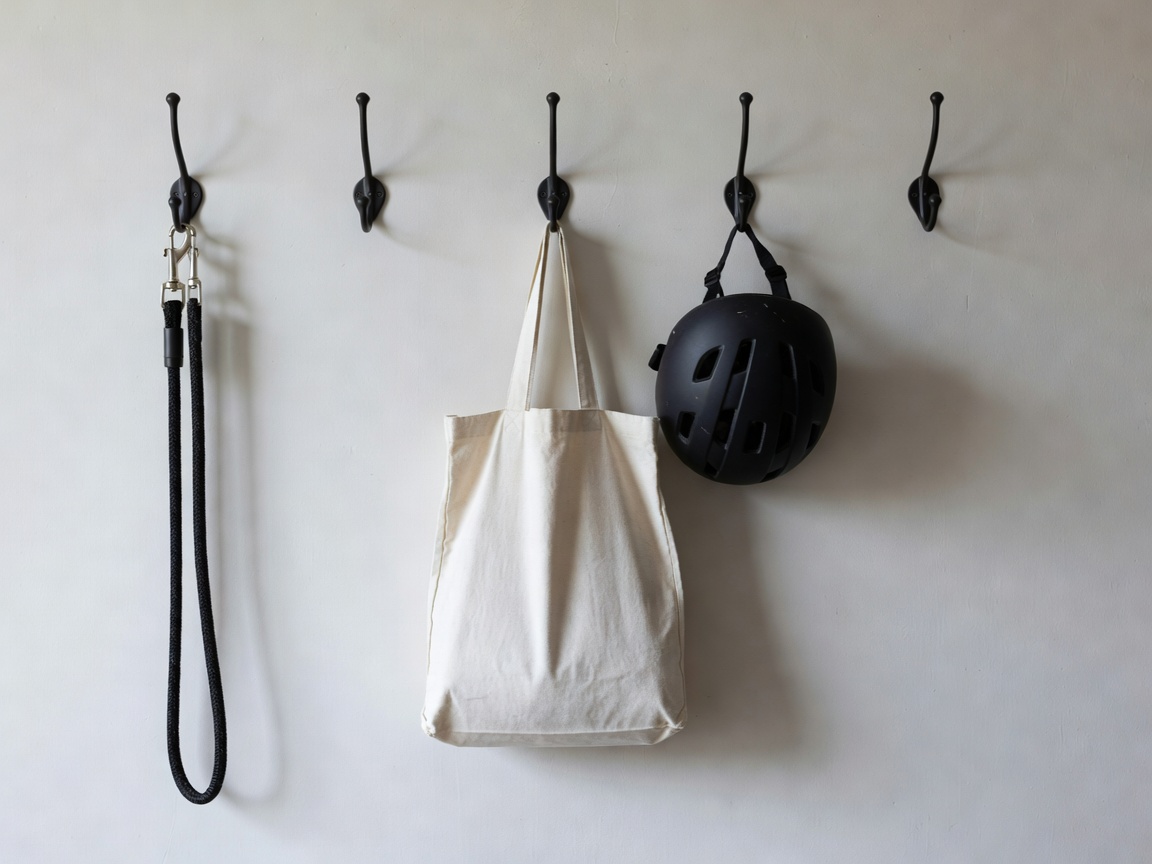
Before moving anything, notice what actually lands. For one week, glance at the area inside your front door each evening and jot down what is there. Most households discover the list is short: keys, phones, wallets, bags, coats, shoes, post, and one or two household-specific items such as a dog lead, a bike helmet or a work lanyard.
This mirrors the first step Julie Morgenstern describes in Organizing from the Inside Out: analyse before you strategize. You are not designing for an imaginary tidy version of yourself. You are designing for the person who walks in tired, carrying shopping, with a phone ringing.
The three-second rule for landing spots
An arrival zone works when putting something away takes about as long as dropping it on the nearest surface. If hanging a coat means opening a wardrobe door, moving a hanger and closing the door again, the coat will end up on the banister. That is not a character flaw; it is a design problem. Dana K. White, in Decluttering at the Speed of Life, makes a similar point about putting things where you would look for them first.
In practice, this means open storage at the door: hooks rather than hangers, a tray rather than a lidded box, a basket rather than a drawer. Place hooks at the height of the shortest regular user. Children who can reach their own hook hang up their own coats far more often.
Keys and small items
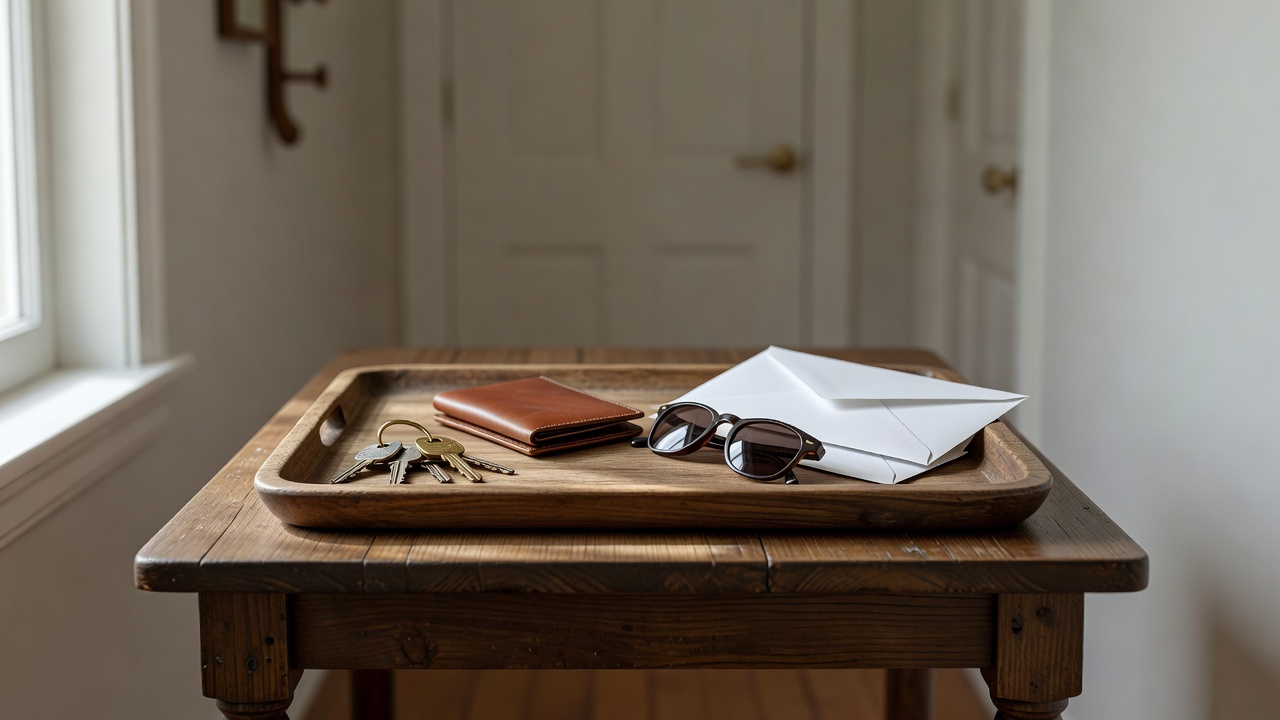
One shallow tray or bowl on the first flat surface you pass. If there is no surface, a small wall shelf or a key hook beside the light switch.
Post and paper
A single upright holder for "to deal with". Recycling for junk mail should be within arm's reach, ideally right there.
Shoes
A low rack or a washable tray for wet shoes. Limit the door rack to shoes worn this week; others move to bedrooms.
Small and shared entryways
Many flats open straight into the living room, and many shared houses have one narrow hallway for five people. You can still create a landing zone. Use vertical space: an over-door hook rail, a wall-mounted shelf just deep enough for a tray, or a slim bench with baskets underneath. In a studio, the "entryway" might simply be the end of a bookcase nearest the door.
In shared homes, give each person one hook and one basket, labelled with their name or a colour. When everyone's things blend into one heap, nobody feels responsible for it. When each person has a visible space, the overflow becomes obvious and easy to discuss without blame.
Keep, move or reconsider
Once you know what lands, sort the entryway's current contents into three simple groups.
Keep at the door
- Daily keys, phone charger if needed
- This week's coats and shoes
- Reusable shopping bags
- Dog lead, umbrella
Move elsewhere
- Off-season coats
- Shoes worn less than weekly
- Sports kit used on one day
- Paperwork older than a week
Reconsider
- Spare umbrellas beyond one each
- Broken or outgrown shoes
- Free tote bags piling up
- Takeaway menus
Unwanted but usable items can go to a local reuse network such as the Buy Nothing Project or the Freecycle Network, or to a charity shop. Do not let "find the perfect home for it" become a new pile by the door: give yourself a deadline, then donate or recycle.
Common obstacles
"There's no wall I'm allowed to drill into."
Renters can use over-door hook rails, freestanding coat stands, tension rods or removable adhesive hooks rated for the weight. A narrow bookcase turned sideways near the door can hold baskets and a tray.
"The tray just fills with clutter."
That is normal. A tray concentrates clutter so it is easy to clear. Empty it during your evening reset; anything that has sat there three days needs a different home.
"My kids drop everything on the floor."
Lower the hooks, use open bins with pictures as labels, and practise the routine together for a couple of weeks. BJ Fogg's Tiny Habits suggests anchoring a new behaviour to an existing one: "After I take my shoes off, I hang my bag."
Maintaining the zone
Give the entryway a two-minute look as part of your evening reset (see Small Resets). Clear the tray, move stray items to their rooms, and recycle junk mail. Once a season, swap coats and shoes, and check whether the hooks still match the people living there. Households change: a new job, a new baby, a new flatmate. The arrival zone should change with them, rather than staying fixed to a plan that made sense two years ago.
If you take one action today, choose the most frequently lost item in your home and give it one obvious, open landing spot within a step of the door.